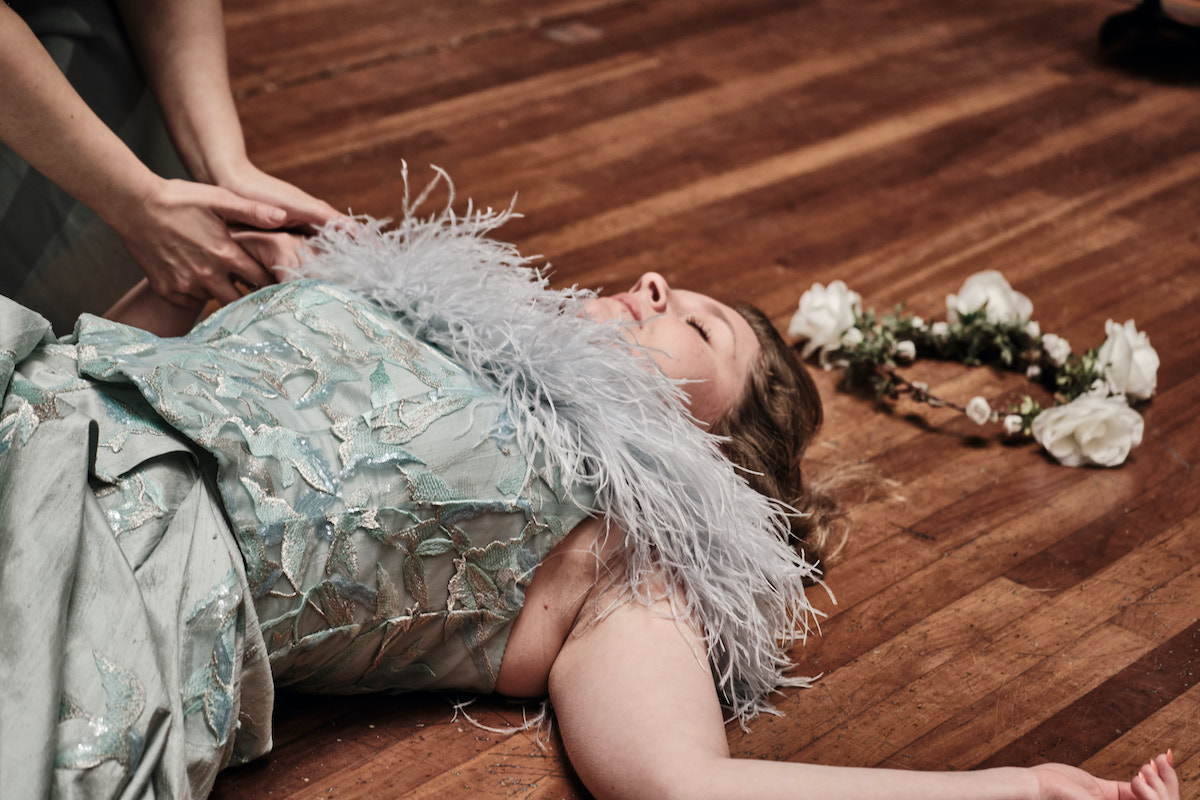
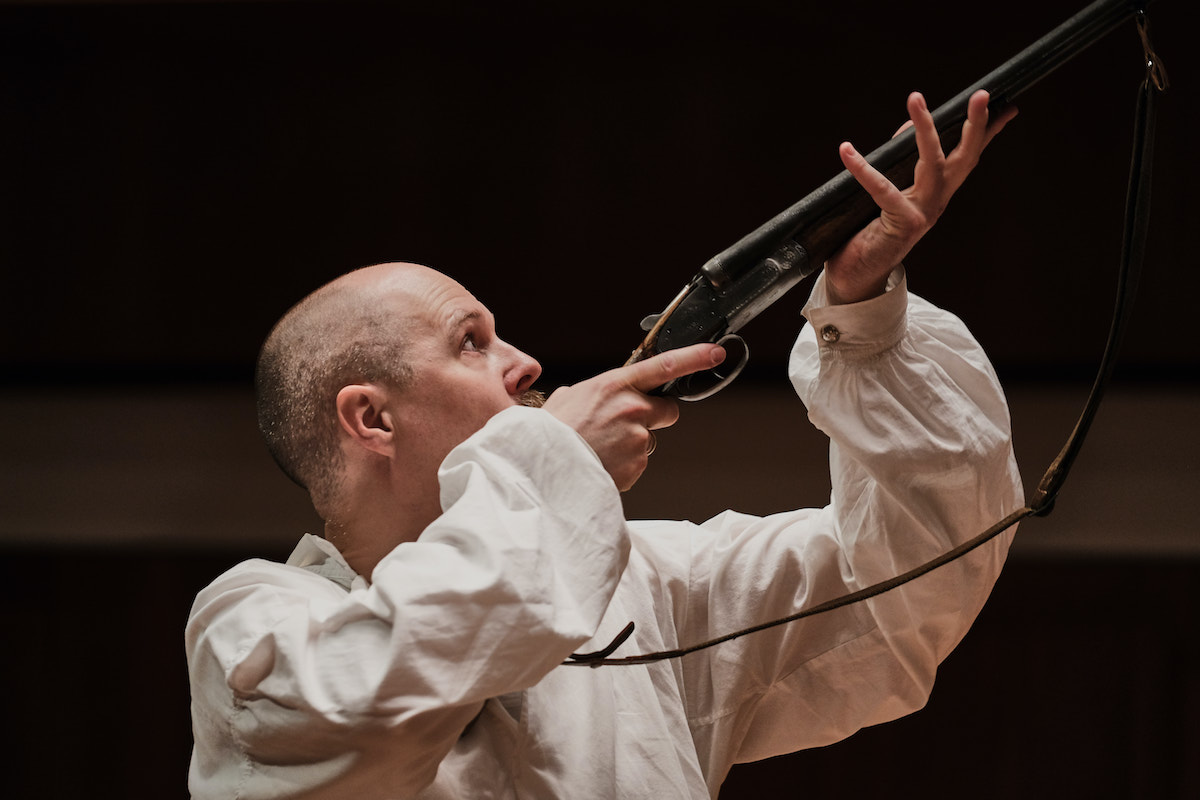
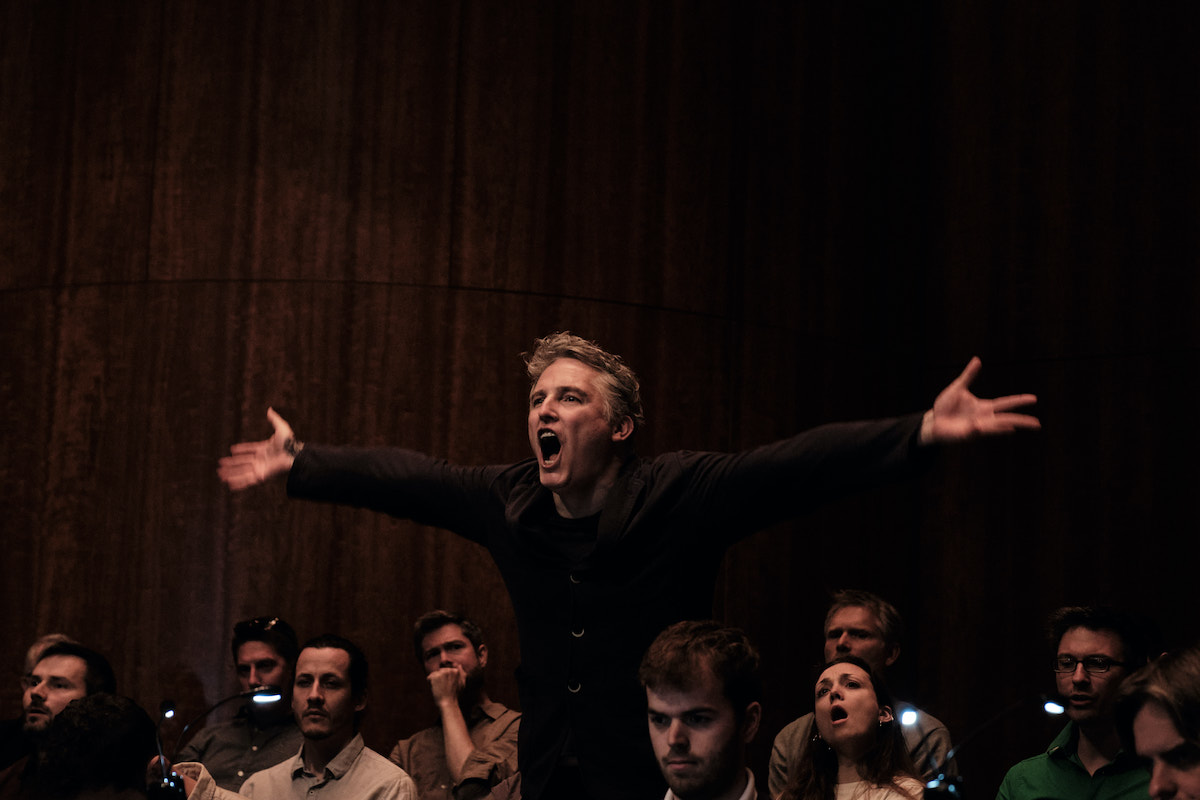
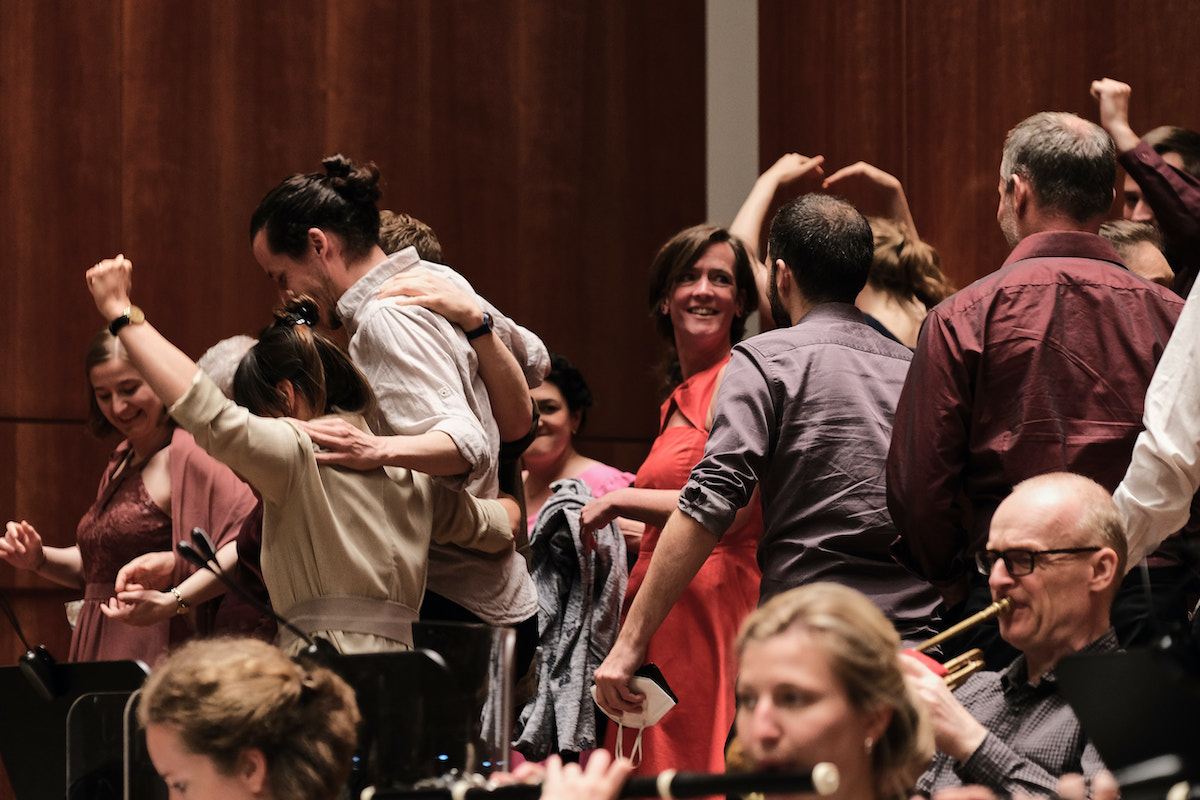
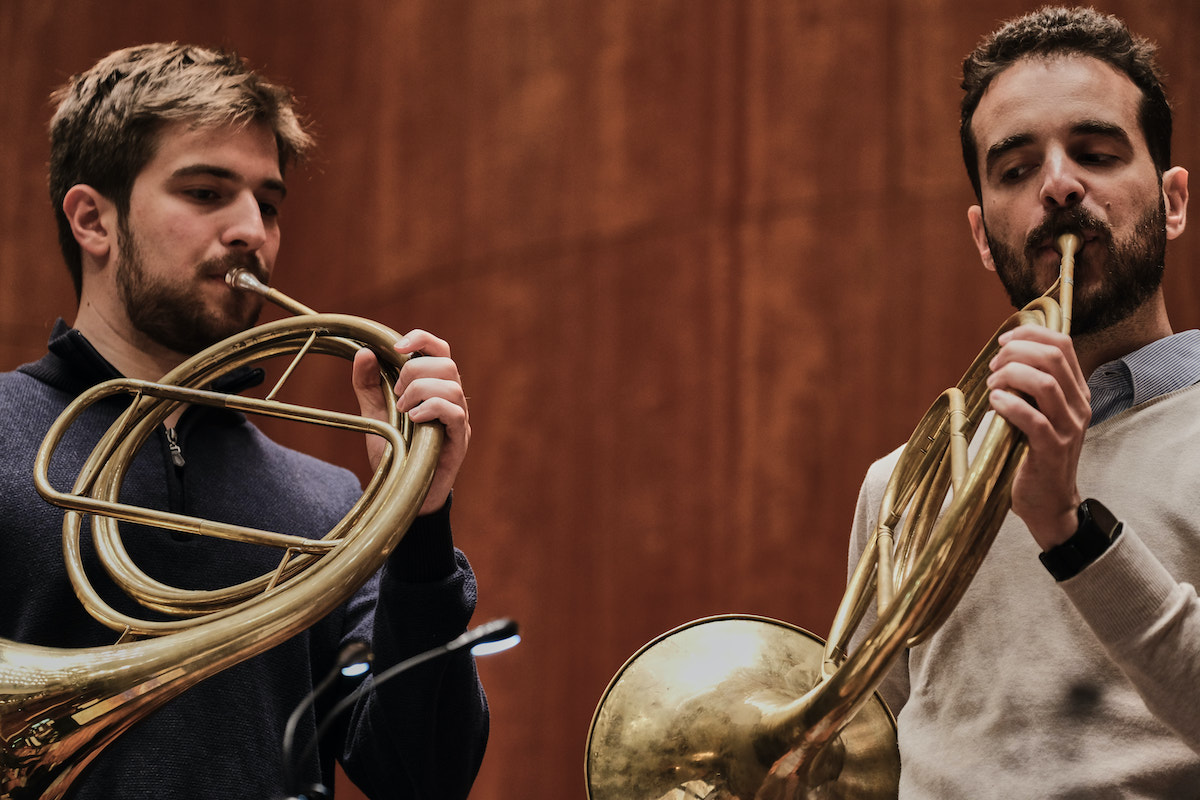
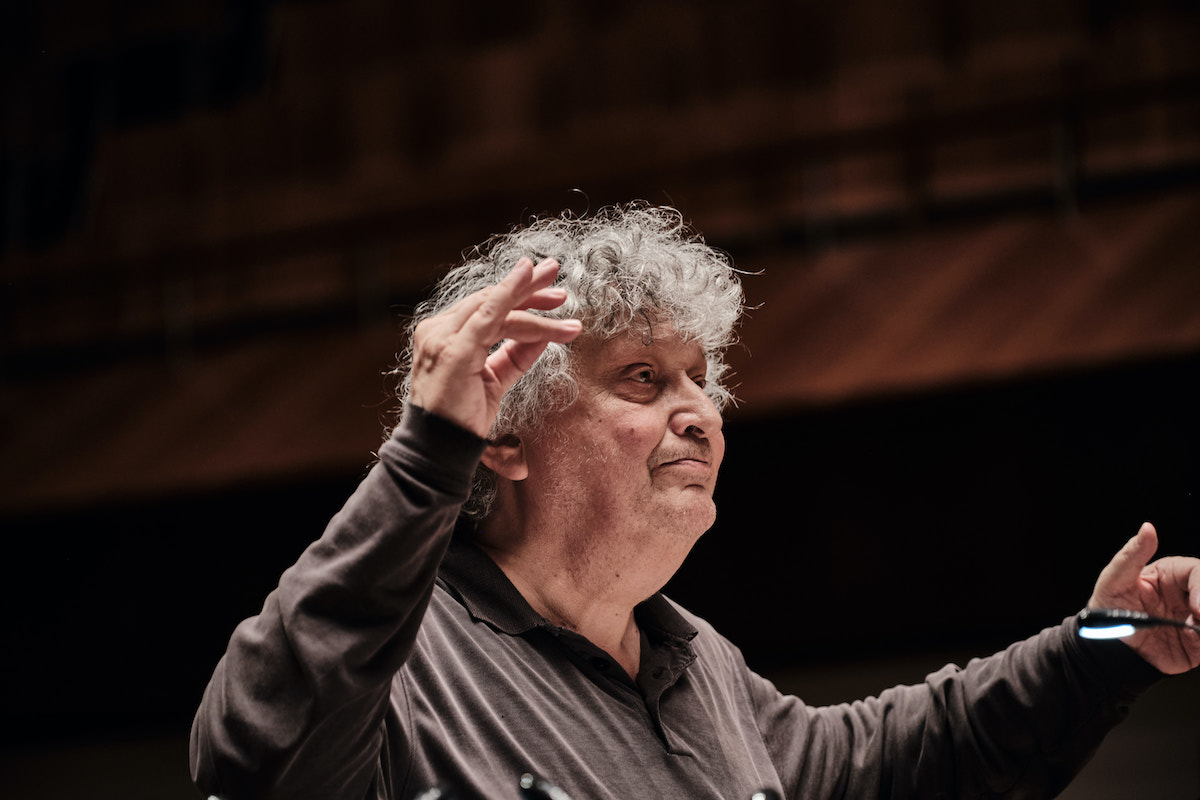
Europa Galante and Fabio Biondi continue a personal Monteverdi tradition in Hamburg.
In April 2019 they debuted at the Elbphilharmonie with Il Ritorno d’Ulisse in Patria (1641), now L’Orfeo (1607) follows. With the title role, Monteverdi created one of the most demanding vocal parts in the history of early opera, which is ideally cast here with the exceptional tenor Ian Bostridge. The orchestra is collaborating with the world-renowned RIAS Kammerchor for the first time on this occasion.
Claudio Monteverdi: L’Orfeo – Favola in musica
Ian Bostridge (Orfeo) / Monica Piccinini (Euridice, La Musica) / Marina de Liso (Messagera, La Speranza) / RIAS Kammerchor / Europa Galante / Fabio Biondi (direction) a.o.
Babylon ORCHESTRA, founded in 2016, is a Berlin-based urban fusion ensemble that combines European and Middle Eastern music with the sound of a big band and contemporary orchestra.
Our aim is to promote intercultural artistic cooperation and thus to give different musical traditions and cultures a place in a new shared and unique sound world of the present. We bring people with their stories, songs, instruments, rhythms in the hope of providing creative impulses for new musical works.
By combining and juxtaposing classical and traditional instruments, such as oud and guitar, ney and flute, kamanche and violin, or other exciting combinations, we also aim to foster a deeper understanding of non-European cultures.
The orchestra also sees itself as a platform for exceptional musicians who do not want to squeeze their art into classical or popular musical forms and instead want to find an expression for the specificity of their countries of origin.
In 2021, the ensemble performed with the Rundfunksinfonieorchester Berlin, the Dortmund Philharmonic Orchestra, at the Office of the German Federal President, the Konzerthaus Berlin and the ODEON Göppingen, among others. In 2022, the ensemble performs in Greece and at several German festivals, releases an EP and makes its debut in Switzerland.
Echoes of Mediterranean is a project by Babylon ORCHESTRA which presents love songs, ballads, personal stories and newly written vocal pieces based on texts by authors who lived in the countries around the Mediterranean or have a relationship to it. Hence, the listener encounters a performance taking him through the history of the Mediterranean cultures. Two to three singers from Greece, Syria and Turkey and 7 to 16 musicians from various countries of the Middle East and Europe are performing together as a mixed ensemble with traditional and modern instruments. By using combinations of composed and improvised elements, acoustic and electric as well as electronic instruments, the ensemble creates a lively and dramatic, almost scenic performance showcasing the richness of this cultural heritage. Sephardic, Arabic, Turkish and Greek folk songs with new arrangements (like f.e. Smirneiko Minore from 1909 from Smyrna or Morena me liaman from Sephardic Jewish tradition in Spain) make the core of this concert program.
“Vital playing joy of epic passion, fueled by centuries-old music: pure emotionality, pure presence.”
Together with cellist-singer Nesrine who combines French, Arabic and English songs in her own music fusing Maghreb styles with Jazz and classical cello, the BABYLON ORCHESTRA perform a program ranging from traditional Algerian, Moroccan and other North African styles alongside new arrangements of classical works from Renaissance and oral tradition.
“Can stories be so captivating that you just want to keep listening? In the case of the Franco-Algerian musician Nesrine, that might well be true.”
NDR Kultur, 7 November 2024
Availability on request COOPERATION WITH SYMPHONY ORCHESTRA
Programme example: Johann Sebastian Bach: Suite No. 3 in C major, BWV 1009, Bourrée I and II Heitor Villa-Lobos: Bachianas Brasileiras No. 9 for string orchestra, W 449 Ludwig van Beethoven: Leonoren Ouverture No. 3, Op. 72b Babylon/Hani Mojtahedy: Improvisation Antonín Dvorak: Symphony No. 9 in E minor, Op. 95, B. 178, 2d movement “Largo” Mischa Tangian: The forgotten Layale Chaker (Arr. L. Chaker/M. Tangian): Frah el Donniye Hani Mojtahedy and Mischa Tangian (Arr. M. Tangian): Nour Osama Abdulrasol: Sumerian harp Isaac Albeniz (Arr. M. Tangian): Suite Española No. 5 “Asturias” César Guerra-Peixe (Arr. M. Tangian): Mourão Hermeto Pascoal (Arr. M. Tangian): O Ovo Johann Sebastian Bach (Arr. M. Tangian): Flute Sonata in E-Flat major, BWV 1031: II, Siciliano Charbel Rohana (Arr. M. Tangian): Sama’i Bayati
Excerpt from the concert of October 14, 2021 / Mensch – Musik – Über Brücken / Babylon Orchestra with the RSB
27 & 28 October 2024, Staatsoper Stuttgart / Liederhalle THE ORDER OF TIME Roshanak Rafani, percussion / Babylon ORCHESTRA & Staatsorchester Stuttgart / Tianyi Lu, conductor
Founder and artistic director, Mischa Tangian, has written a work for orchestra and percussion for the Staatsorchester Stuttgart, which was premiered in Stuttgart at the end of October 2024. The work, entitled The Order of Time, centers on the encounter between European and non-European musical cultures and their instruments. The soloist for the evening was Iranian percussionist Roshanak Rafani, conducted by Tianyi Lu.
Works by G. Kancheli, M. Tangian (world premiere) & A. Dvořák
“Asian music and European sounds blended with an expressive musical language.”
Onnline Merker, 27 October 2024
14 August 2023, Berlin WASSERMUSIK AUF DER SPREE Babylon ORCHESTRA / Mischa Tangian, violin & leader
As part of Berlin’s Summer Festival of Culture 2023, Babylon ORCHESTRA and Sarahbanda, founded by Sarah Willis, set sail on two rafts and immerse the audience on the shores between Holzmarkt 25 and Funkhaus Berlin in rousing Mediterranean, Middle Eastern and Caribbean worlds of sound. They dropped anchor at the landing stages Mercedes Benz Arena/East Side Gallery and Funkhaus Berlin on Nalepastrasse. The ensembles played half-hour concerts at both stops, two at the East Side Gallery and one at the Funkhaus.
We are very happy about the victory of Rossini’s “Petite Messe Solennelle” wonderful recording by Giulio Prandi and Coro Ghislieri in the category “choral music” if the International Classical Music Awards 2022!
“The Petite Messe Solennelle is an enigmatic and mysterious masterpiece. Perhaps it is only with this recording (which for the first time makes use of the new critical edition), wonderfully conducted by Giulio Prandi with the Ghislieri Choir and four top class singers, that we can truly understand the mysteries of the old Rossini, who winks at the opera theatre but from a now distanced perspective.” ICMA’s jury
The news of this award surprised and delighted me. It is the corollary of a journey that began twenty years ago; the extraordinary adventure of a group of young artists who came together in an ensemble, animated by the desire to get to the bottom of a marvellous and much-loved repertoire, that of Italian 18th century vocal music, through radical study and research. The only focal point is to bring out not only the beauty, but also the profound ability of this music to speak to the contemporary world. We would not have got this far without the Fondazione Collegio Ghislieri, which has strongly supported this project, first and foremost through Professor Andrea Belvedere. In his more than forty years as Rector, he has shaped the Ghislieri of the Future, and the Centro di Musica Antica Ghislieri, of which he is still President, is one of his most significant achievements, the result of five decades of hard, constant, patient work.
In an extremely difficult historical moment, in a country where the music scene has tended to shrink, in perpetual suffering, the Ghislieri is entering a new phase. After the Abbiati Prize in 2019, the award for “best choral record” at the ICMA 2021 makes us look to the future with renewed enthusiasm. The Coro e Orchestra Ghislieri have many concerts and recordings to perform between now and 2024, as well as many of my commitments as conductor. My personal activity, through encounters with different and extraordinary orchestras, choirs and artists, allows me to compare notes, increase my experience and mature my sensitivity. These experiences I then bring back home, to Ghislieri, putting them at the service of my wonderful musicians, so that I can grow even more with them. Therefore, I sincerely thank the ICMA jury and, with it, all those who believed in me and in the Ghislieri artistic project. A deep gratitude, which turns into energy and desire to go forward.
Once again we look back on a challenging year that kept the music world and its players constantly on tenterhooks: complete closures of theatres and concert halls at the beginning of the year, cautious attempts in early summer to get concert life going again by means of sophisticated hygiene concepts, finally almost “normal” performances under 3G, 2G and/or 2G+ at the beginning of the season, when quite a few already thought they were at the end of the pandemic tunnel. Now we are once again in the midst of a huge wave, which we hope to weather well together!
Nevertheless, the year 2021 brought many rays of hope that strengthened us in our actions, inspired us to new plans and brought us together with new partners – the latter often virtually, but time and again also analogue and personally. First and foremost, of course, were the wonderful concerts that took place, especially in the second half of the year: the Chamber Orchestra of Europe, which has been delighting international concert audiences for 40 years now, returned to the Berlin Philharmonie with Sir András Schiff, as did Teodor Currentzis and musicAeterna, who, as usual, “made the Phlharmonie quake”, as the Tagesspiegel Berlin commented. Iván Fischer and the Budapest Festival Orchestra and the Freiburger Barockorchester provided fantastic concert experiences, as did the La Folia Barockorchester and the Finnish Baroque Orchestra, the Oberon Trio, the Berlin StegreifOrchester and the Belgian choir Vox Luminis.
Life within the agency also provided ample opportunity to keep moving: In mid-June we moved into a larger and even nicer office within our Schöneberg neighbourhood, which is also almost completely furnished by the end of the year 😉 We like our new website at least as much, which we were able to launch at the beginning of December.
Before we start our Christmas holidays, we would like to wish you a Merry Christmas and a Happy New Year!
Our office will be closed between 23 December 2021 and 03 January 2022.
Chaarts Chamber Artists with Anna-Maria and Malte Arkona, acting
»A midsummer night’s dream«
Shakespeare’s legendary stage play combined with Mendelssohn’s playful incidental music – an evening to dream about. Anna-Maria Arkona had imagined a romantic evening for two differently. Instead of taking her out to dinner, Malte tells her that he has unfortunately mixed up his schedule and now has to go to a performance of Shakespeare’s A Midsummer Night’s Dream. Before she knows it, Anna is on her way with Malte to the scene of the old, but always new, comedy of errors in ancient Athens. Anna, like probably all of us, still roughly remembers the story of two pairs of lovers who get caught up in the marital quarrel of a pair of elves and, thanks to magic flowers, at some point no longer know who they actually love. But how exactly the four different storylines are connected and how many characters there really are, she doesn’t really know any more. Malte rushes to her aid and assigns each character a matching headdress for better recognition. In a game of “changing trees”, the two of them move through Shakespeare’s world and tell his story in their own words. But Anna and Malte are not alone for long. The CHAARTS ensemble accompanies them musically through the story and accompanies the action with appropriate music written by Felix Mendelssohn-Bartholdy. The highlight of the musical journey is the world-famous wedding march at the end of the story for the solemn marriage of all loving couples.
Vox Luminis Choir and Orchestra with Lionel Meunier, bass & direction
»Spem in Alium«
T. Tallis (1505 – 1585): Spem in alium (a 40) A. Striggio (1536 – 1592): Ecce beata lucem (a 40) R. Carver (c1485/c1570): O bone Jesus (a 19) J. Sheppard (1515 – 1558): Media vita in morte sumus (a 6/8) J. Desprez (1450/1455 – 1521): Qui habitat in adiutorio Altissimi (a 24) A. Striggio (1536 – 1592): Ecce beata lucem (a 40)
Il Giardino Armonico with Giovanni Antonini, direction & recorder // Anna Prohaska, soprano
»Serpent & Fire«
Henry Purcell: Overture + Ah! Belinda, I’m press’d with torment from Dido and Aeneas Christoph Graupner: Holdestes Lispeln der spielenden Fluthen from Dido, Königin von Karthago Antonio Sartorio: Non voglio amar from Giulio Cesare in Egitto Matthew Locke: Extracts from The Tempest D. Castrovillari: A Dio regni, a Dio scettri from La Cleopatra Antonio Sartorio: Quando voglio from Giulio Cesare in Egitto Henry Purcell: Chaconne – Dance for Chinese Man and Woman from The Fairy Queen Christoph Graupner: Der Himmel ist von Donner + Infido Cupido – Agitato da Tempeste from Dido, Königin von Karthago Giuseppe Sammartini: Concerto in F major for recorder, strings and b. c. Johann Adolph Hasse: Già si desta la tempesta from Didone abbandonata Georg Friedrich Händel: Che sento? Oh Dio! … Se pietà di me non senti from Giulio Cesare in Egitto Dario Castello: Sonata Decimaquinta a quattro in D major Francesco Cavalli: Re de’ Getuli Altero … Il mio marito from Didone Johann Adolph Hasse: Morte col fiere aspetto aus Marc Antonio e Cleopatra Luigi Rossi: Passacaille Del Seigneur Luigi Henry Purcell: Oft she visits this lone mountain – Thy hand, Belinda.. When I am laid in earth from Dido and Aeneas
orchestration: version with 8 or 16 instruments possible
B’Rock Orchestra with Alexander Melkinov, fortepiano, artistic direction and concept
»Beethoven – The listeners academy«
Beethoven’s Piano Concertos as you have never experienced them before: Just as Leonard Bernstein shared insights into masterpieces of music history with a broad audience (in concert and as a TV format) in “Bernstein on…”, Alexander Melkinov and B’Rock will provide their vision and interpretation of Beethoven’s piano concertos in a well-conceived (and entertaining!) semi-staged format, then perform the full concerto for an audience of activated listeners.
Different formats possible: – compact 1h concert, focus on one Beethoven Concerto (which can then be presented twice or even three times in a day) – double formats, featuring both Concertos no. 1 and 2 (full evening length) – mix formats: “Listeners Academy” with focus on one concerto in the first half, 2nd – half presenting Beethoven Symphony no. 1 and Beethoven Chamber Music with Fortepiano tbc
B’Rock Orchestra with Evgeny Sviridov, artistic director // Nardus Williams, soprano
»Adventurers, or: a dirty business«
Within Adventurers, B’Rock puts the finger where it hurts and directs the view of its audiences towards a widely overseen fact: the multifaceted relations between (Baroque) Music and oppression of Black People. From economical dependency of Handel’s opera endeavors on the exploitation of Black people to open racism in the European “music industry” of the 18th century, B’Rock wants to point towards mechanisms that still echo in today’s society.
Georg Friedrich Händel: Overture, from Water Music Suite 1 HWV 348 Recitative and Air, from Acis and Galathea HWV 49 Rigaudon & Menuett from Wassermusik Suite Nr. 3 HWV 350 Arie Make me a clean heart aus Chandos Anthem Nr. 3 Have Mercy upon Me, O God HWV 248 Air aus Wassermusik Suite Nr. 1 HWV 348 Excerpts from Esther HWV 50 Carl Theodor Pachelbel: God of sleep, for whom I Linguish (with soprano) Joseph Boulogne Chevalier de Saint-Georges: Ouverture, from ballet L’amant anonyme Contredanse, from ballet no. 1 & 6 from L’amant anonyme Symphonie in G op. 11 no. 1
Chaarts Chamber Artists with Regula Mühlemann, soprano
»Fairy Tales«
In the world of fairies, their enchanting sounds, and beguiling songs – surrounded by the mysticism of the North and its dazzling world of legends – the Swiss soprano Regula Mühlemann and the international chamber ensemble CHAARTS are literally on the ‘wings of song’. Here, grand opera, filigree singspiel and fulminant orchestral suites are fused into gripping immediacy by the congenial instrumental art of Wolfgang Renz for eleven instruments, and in the dialogue between the singer and the eleven musicians, oases of the finest musicality as well as sound spaces of remarkable fullness open up.
Edvard Grieg: Suite from Peer Gynt Nr. 1 op. 46 Vier Lieder: Solveigs Wiegenlied (Peer Gynt), Frühling (Lieder op. 33), Ein Schwan (6 Lieder op. 25), Solveigs Lied (Peer Gynt) Giuseppe Verdi: Ninfe! Elfi! Silfi! … Sul fil d’un soffio eteseo (Aria of Nannetta from Falstaff) Felix Mendelssohn Bartholdy: In dem Mondenschein im Walde op. 19 Nr. 4, Ouverture, Bunte Schlangen zweigezüngt, Scherzo, Bei des Feuers mattem Flimmern (Ein Sommernachtstraum) Antonín Dvořák: Lied an den Mond (Rusalka) Charles Gounod: Je veux vivre dans le rêve (Aria of Juliette from Roméo et Juliette)
And other works by Jules Massenet, Benjamin Britten, Henry Purcell and others.
B’Rock Orchestra with Antoine Tamestit, artistic director and viola
»Tears of Melancholy«
“Neither are the tears always shed in sorrowe, but sometimes in joy and gladnesse” Preceding his Lachrimae or Seven Tears, John Dowland indicates that each tear, each of his seven slow, stately pavanes, is different. Sighing and sad tears next to sincere and loving ones: In this programme, directed by the award-winning French violist Antoine Tamestit, Dowland’s Lachrimae sound like an overture, the prelude to a moving musical journey through which melancholy is woven as a thread.
John Dowland: Lachrimae or Seven Tears Benjamin Britten: Lachrymae op. 48a for Viola and Strings Henry Purcell: Suite Z 770 Henry Purcell: Chaconne in g Z 730 Georg Muffat: Concerto IV Dulce Somnium Paul Hindemith: Trauermusik for Viola and Strings Georg Muffat: Concerto VI – Saeculum
Orchestra of the Eighteenth Century Alexander Janiczek, conductor Ilse Eerens, soprano
»Scena di Berenice«
Joseph Haydn: Scena di Berenice Jean-Fery Rebel: Les Éléments
Alternative programe: Joseph Haydn: Symphony no. 6 in D major “Le Matin” Joseph Haydn: Symphony no. 7 in C major “Le Midi” Joseph Haydn: Symphony no. 8 in G major “Le Soir” Jean-Fery Rebel: Les Éléments
Chaarts Chamber Artists with Anna-Maria and Malte Arkona, acting
»A midsummer night’s dream«
Shakespeare’s legendary stage play combined with Mendelssohn’s playful incidental music – an evening to dream about. Anna-Maria Arkona had imagined a romantic evening for two differently. Instead of taking her out to dinner, Malte tells her that he has unfortunately mixed up his schedule and now has to go to a performance of Shakespeare’s A Midsummer Night’s Dream. Before she knows it, Anna is on her way with Malte to the scene of the old, but always new, comedy of errors in ancient Athens. Anna, like probably all of us, still roughly remembers the story of two pairs of lovers who get caught up in the marital quarrel of a pair of elves and, thanks to magic flowers, at some point no longer know who they actually love. But how exactly the four different storylines are connected and how many characters there really are, she doesn’t really know any more. Malte rushes to her aid and assigns each character a matching headdress for better recognition. In a game of “changing trees”, the two of them move through Shakespeare’s world and tell his story in their own words. But Anna and Malte are not alone for long. The CHAARTS ensemble accompanies them musically through the story and accompanies the action with appropriate music written by Felix Mendelssohn-Bartholdy. The highlight of the musical journey is the world-famous wedding march at the end of the story for the solemn marriage of all loving couples.
Freiburger Barockorchester with Valer Sabadus, soprano / Terry Wey, alto
N.Fiorenza: Concerto in D major N. Porpora: Crimen adae quantum constat F. Durante: Concerto in C major N.N.:(tbc) G. B. Pergolesi: Stabat Mater in F minor P. 77
B’Rock Orchestra with Antoine Tamestit, artistic director and viola
»Tears of Melancholy«
“Neither are the tears always shed in sorrowe, but sometimes in joy and gladnesse” Preceding his Lachrimae or Seven Tears, John Dowland indicates that each tear, each of his seven slow, stately pavanes, is different. Sighing and sad tears next to sincere and loving ones: In this programme, directed by the award-winning French violist Antoine Tamestit, Dowland’s Lachrimae sound like an overture, the prelude to a moving musical journey through which melancholy is woven as a thread.
John Dowland: Lachrimae or Seven Tears Benjamin Britten: Lachrymae op. 48a for Viola and Strings Henry Purcell: Suite Z 770 Henry Purcell: Chaconne in g Z 730 Georg Muffat: Concerto IV Dulce Somnium Paul Hindemith: Trauermusik for Viola and Strings Georg Muffat: Concerto VI – Saeculum
Chaarts Chamber Artists with Regula Mühlemann, soprano
»Fairy Tales«
In the world of fairies, their enchanting sounds, and beguiling songs – surrounded by the mysticism of the North and its dazzling world of legends – the Swiss soprano Regula Mühlemann and the international chamber ensemble CHAARTS are literally on the ‘wings of song’. Here, grand opera, filigree singspiel and fulminant orchestral suites are fused into gripping immediacy by the congenial instrumental art of Wolfgang Renz for eleven instruments, and in the dialogue between the singer and the eleven musicians, oases of the finest musicality as well as sound spaces of remarkable fullness open up.
Edvard Grieg: Suite from Peer Gynt Nr. 1 op. 46 Vier Lieder: Solveigs Wiegenlied (Peer Gynt), Frühling (Lieder op. 33), Ein Schwan (6 Lieder op. 25), Solveigs Lied (Peer Gynt) Giuseppe Verdi: Ninfe! Elfi! Silfi! … Sul fil d’un soffio eteseo (Aria of Nannetta from Falstaff) Felix Mendelssohn Bartholdy: In dem Mondenschein im Walde op. 19 Nr. 4, Ouverture, Bunte Schlangen zweigezüngt, Scherzo, Bei des Feuers mattem Flimmern (Ein Sommernachtstraum) Antonín Dvořák: Lied an den Mond (Rusalka) Charles Gounod: Je veux vivre dans le rêve (Aria of Juliette from Roméo et Juliette)
And other works by Jules Massenet, Benjamin Britten, Henry Purcell and others.
Chaarts Chamber Artists with Regula Mühlemann, soprano
»Fairy Tales«
In the world of fairies, their enchanting sounds, and beguiling songs – surrounded by the mysticism of the North and its dazzling world of legends – the Swiss soprano Regula Mühlemann and the international chamber ensemble CHAARTS are literally on the ‘wings of song’. Here, grand opera, filigree singspiel and fulminant orchestral suites are fused into gripping immediacy by the congenial instrumental art of Wolfgang Renz for eleven instruments, and in the dialogue between the singer and the eleven musicians, oases of the finest musicality as well as sound spaces of remarkable fullness open up.
Edvard Grieg: Suite from Peer Gynt Nr. 1 op. 46 Vier Lieder: Solveigs Wiegenlied (Peer Gynt), Frühling (Lieder op. 33), Ein Schwan (6 Lieder op. 25), Solveigs Lied (Peer Gynt) Giuseppe Verdi: Ninfe! Elfi! Silfi! … Sul fil d’un soffio eteseo (Aria of Nannetta from Falstaff) Felix Mendelssohn Bartholdy: In dem Mondenschein im Walde op. 19 Nr. 4, Ouverture, Bunte Schlangen zweigezüngt, Scherzo, Bei des Feuers mattem Flimmern (Ein Sommernachtstraum) Antonín Dvořák: Lied an den Mond (Rusalka) Charles Gounod: Je veux vivre dans le rêve (Aria of Juliette from Roméo et Juliette)
And other works by Jules Massenet, Benjamin Britten, Henry Purcell and others.
B’Rock Orchestra with Antoine Tamestit, artistic director and viola
»Tears of Melancholy«
“Neither are the tears always shed in sorrowe, but sometimes in joy and gladnesse” Preceding his Lachrimae or Seven Tears, John Dowland indicates that each tear, each of his seven slow, stately pavanes, is different. Sighing and sad tears next to sincere and loving ones: In this programme, directed by the award-winning French violist Antoine Tamestit, Dowland’s Lachrimae sound like an overture, the prelude to a moving musical journey through which melancholy is woven as a thread.
John Dowland: Lachrimae or Seven Tears Benjamin Britten: Lachrymae op. 48a for Viola and Strings Henry Purcell: Suite Z 770 Henry Purcell: Chaconne in g Z 730 Georg Muffat: Concerto IV Dulce Somnium Paul Hindemith: Trauermusik for Viola and Strings Georg Muffat: Concerto VI – Saeculum
Chaarts Chamber Artists with Regula Mühlemann, soprano
»Fairy Tales«
In the world of fairies, their enchanting sounds, and beguiling songs – surrounded by the mysticism of the North and its dazzling world of legends – the Swiss soprano Regula Mühlemann and the international chamber ensemble CHAARTS are literally on the ‘wings of song’. Here, grand opera, filigree singspiel and fulminant orchestral suites are fused into gripping immediacy by the congenial instrumental art of Wolfgang Renz for eleven instruments, and in the dialogue between the singer and the eleven musicians, oases of the finest musicality as well as sound spaces of remarkable fullness open up.
Edvard Grieg: Suite from Peer Gynt Nr. 1 op. 46 Vier Lieder: Solveigs Wiegenlied (Peer Gynt), Frühling (Lieder op. 33), Ein Schwan (6 Lieder op. 25), Solveigs Lied (Peer Gynt) Giuseppe Verdi: Ninfe! Elfi! Silfi! … Sul fil d’un soffio eteseo (Aria of Nannetta from Falstaff) Felix Mendelssohn Bartholdy: In dem Mondenschein im Walde op. 19 Nr. 4, Ouverture, Bunte Schlangen zweigezüngt, Scherzo, Bei des Feuers mattem Flimmern (Ein Sommernachtstraum) Antonín Dvořák: Lied an den Mond (Rusalka) Charles Gounod: Je veux vivre dans le rêve (Aria of Juliette from Roméo et Juliette)
And other works by Jules Massenet, Benjamin Britten, Henry Purcell and others.